
current in Physics
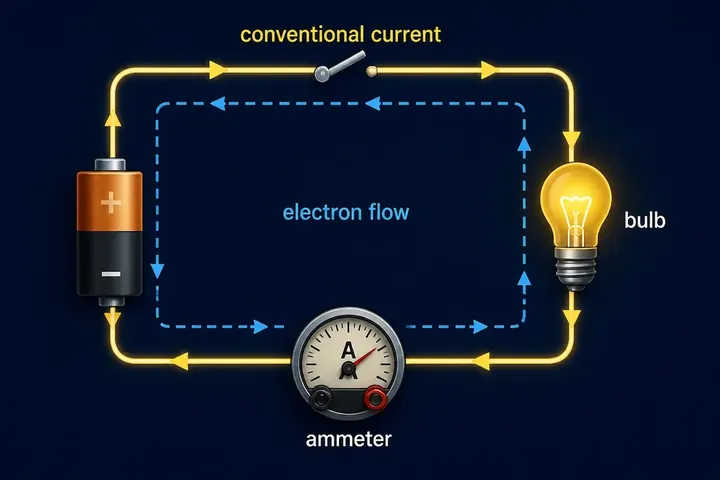
The rate of flow of electric charge through a conductor; SI unit ampere (1 A = 1 C/s).
Current flows when a potential difference pushes charges, usually electrons, around a closed circuit. Conventional current is taken from + to −, opposite to electron flow.
Meaning in your language
विद्युत धारा — किसी चालक से होकर आवेश प्रवाह की दर; मात्रक ऐम्पियर
धारा तब प्रवाहित होती है जब विभवांतर आवेशों, प्रायः इलेक्ट्रॉनों, को बंद परिपथ में धकेलता है। परिपाटी के अनुसार धारा + से − की ओर मानी जाती है, जो इलेक्ट्रॉन प्रवाह के विपरीत है।
تيار كهربائي: معدل تدفق الشحنة الكهربائية عبر موصل، ووحدته الأمبير
يسري التيار حين يدفع فرق الجهد الشحنات، وهي عادةً إلكترونات، عبر دائرة مغلقة. ويُعتبر التيار الاصطلاحي من + إلى −، أي عكس اتجاه سريان الإلكترونات.
courant (intensité) : débit de charge électrique à travers un conducteur ; unité l'ampère
Le courant circule quand une différence de potentiel pousse des charges, généralement des électrons, dans un circuit fermé. Le sens conventionnel du courant va de + à −, à l'opposé du mouvement des électrons.
arus listrik: laju aliran muatan listrik melalui penghantar; satuan ampere
Arus mengalir ketika beda potensial mendorong muatan, biasanya elektron, mengelilingi rangkaian tertutup. Arah arus konvensional diambil dari + ke −, berlawanan dengan aliran elektron.
电流:单位时间内通过导体横截面的电荷量,单位安培
当电势差推动电荷(通常是电子)在闭合电路中移动时,就形成电流。规定电流方向从 + 到 −,与电子运动方向相反。
Examples
- If 10 C of charge passes a point in 5 s, the current is 2 A.
- A 1000 W electric kettle on 230 V mains draws a current of about 4.3 A.
Everyday meaning
Happening, existing or being used now.